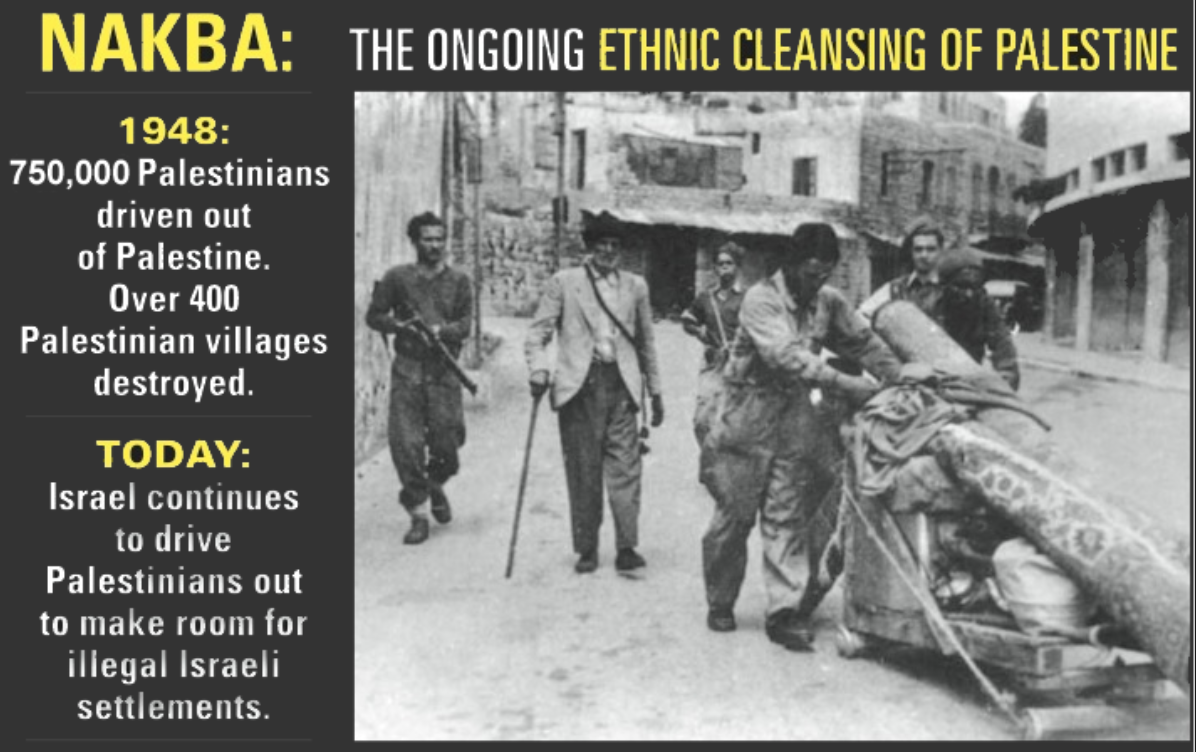
the term denoting the day Jews planted trees, built farms, and installed paved roads, electricity, and indoor toilets, to a land the Arabs had been neglecting and abusing for a millennium.
On stolen land and water AFTER cringing behind an iron wall of British bayonets for a generation.
The Nakba | The Daily Blog
Gee Muzzie Beast, there must of been billions of these mythical Arabs in tiny Israel.
Of course like all followers of the demon Allah, you are a blatant liar (he is the father of lies according the the Christians). The Arabs attacked the Jews because they demanded that all Israel and the rest of the world really, belongs to them.
{
The first phase was confined to the borders of Mandatory Palestine. From the time the British decided to quit Palestine — and especially from the UN partition vote of November 1947 — a guerilla war erupted inside the Mandatory territories. Incited by their catastrophically extremist and incompetent leadership, Palestinian militias conducted attacks on Jewish settlements, using tactics that often crossed the line from irregular to frankly terroristic.
At first, these attacks had some success. The small Jewish settler community (the Yishuv as it was called) lacked almost all the instrumentalities of war. But it had huge advantages too: above all (and this is the point that Morris stresses) a powerful sense of community and sacrifice. These were people for whom extermination was not an abstract or hypothetical threat. Seldom has there been a more spectacular demonstration of Tocqueville’s observation about the military power of a democracy on the defensive.
Palestinian society by contrast proved as friable as old mortar plaster. It crumbled under pressure. As Morris notes, there seems not a single example of an elite family taking part in the fighting. King Abdullah of Jordan, in a message urging Palestinians not to flee, insisted that everybody remain to fight the Jews except for the old, the sick, women, children … and the rich.
In 1947, the Palestinians paid the price for the Arab Uprising of 1936-37. That year’s strife had begun as a pogrom against the Jews and ended as a civil war within the Palestinian community. The grand mufti of Jerusalem, Muhammad al-Husseini, had instigated the uprising — then devoted as much energy to murdering his internal Arab opponents and clan rivals as to fighting the Jews or the British. The uprising ended in a defeat that left Palestinian society not only weaker and poorer, but also riven by family feuds and internecine hatreds.
After the UN vote, the Palestinians cracked under the strain of a war they had themselves launched. Dissident groups within the Yishuv — notably the more radical Irgun — submitted to political authority; the Palestinians turned on each other. The Jewish militias came to look and act more and more like a regular army; the Palestinian militias disintegrated into localized gangs. By the time the British evacuated Palestine in May 1948, the internal phase of the war had ended in bloody but decisive triumph for the Jews.
This unexpected and unwelcome outcome presented the neighboring Arab states with an unhappy dilemma. Their populations utterly rejected a Jewish presence in Palestine. (While it’s often suggested that the Arab-Israeli dispute was “national” at the beginning and only became “religious” in the 1980s and 1990s, Morris notes that the Arabs themselves used the language of Islam and jihad from the very beginning.)
}
1948: A History of the First Arab-Israeli War | David Frum