Historical Source of Revenue as Share of GDP
Carters last year -1981 F/Y Indiv income tax
9.1% GDP
Reagan's first year 1982 F/Y
9.0% GDP
Reagan's second year 1983 F/Y
8.2% GDP
Reagan's third year 1984 F/Y
7.5% GDP
SEE A TREND? LOL
1983, which was the first full fiscal year during which the 50 percent top federal income tax rate was in effect.
Historical Source of Revenue as Share of GDP
Bush CEA Chair Mankiw: Claim That Broad-Based Income Tax Cuts Increase Revenue Is Not "Credible."
Reagan Economist Feldstein: "It Is Not That You Get More Revenue By Lowering Tax Rates, It Is That You Don't Lose As Much."
Feldstein In 1986: "Hyperbole" That Reagan Tax Cut "Would Actually Increase Tax Revenue."
Conservative Economist Holtz-Eakin: "No Serious Research Evidence" Suggests Tax Cuts Pay For Themselves."
Tax cuts do NOT pay for themselves. -Alan Greenspan Former Federal Reserve Chairman
Bush CEA Chair Mankiw: Claim That Broad-Based Income Tax Cuts Increase Revenue Is Not "Credible," Capital Income Tax Cuts Also Don't Pay For Themselves
Bush-Appointed Federal Reserve Chair Bernanke: "I Don't Think That As A General Rule Tax Cuts Pay For Themselves."
Bush Treasury Secretary Paulson: "As A General Rule, I Don't Believe That Tax Cuts Pay For Themselves."
Bush OMB Director Nussle: "Some Say That [The Tax Cut] Was A Total Loss. Some Say They Totally Pay For Themselves. It's Neither Extreme."
Bush CEA Chairman Lazear: "As A General Rule, We Do Not Think Tax Cuts Pay For Themselves."
Bush Economic Adviser Viard: "Federal Revenue Is Lower Today Than It Would Have Been Without The Tax Cuts."
Bush Treasury Official Carroll: "We Do Not Think Tax Cuts Pay For Themselves."
Lets take a look at Revenues after the Reagan tax cuts adjusted for inflation:
Historical Federal Receipt and Outlay Summary
Once you take out the effects of inflation, you see that for 5 years, all the increase in revenues was solely because of inflation.
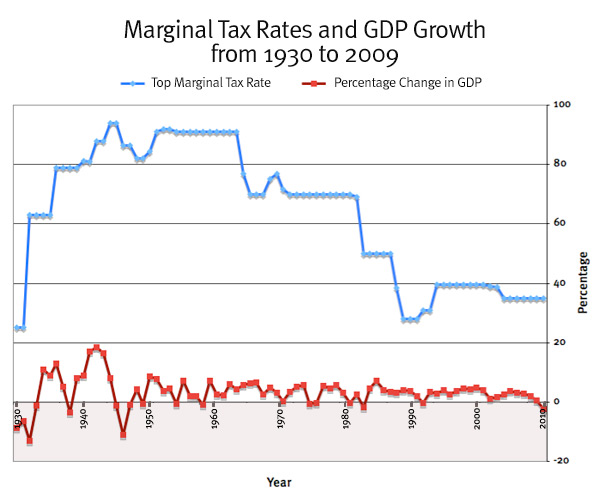
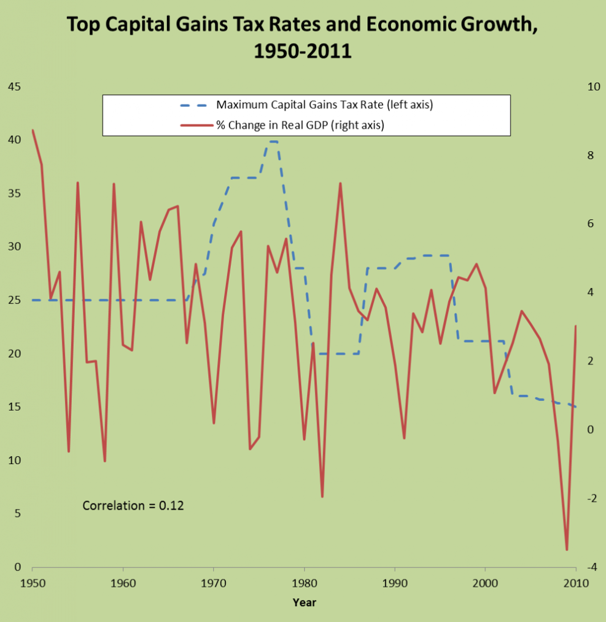
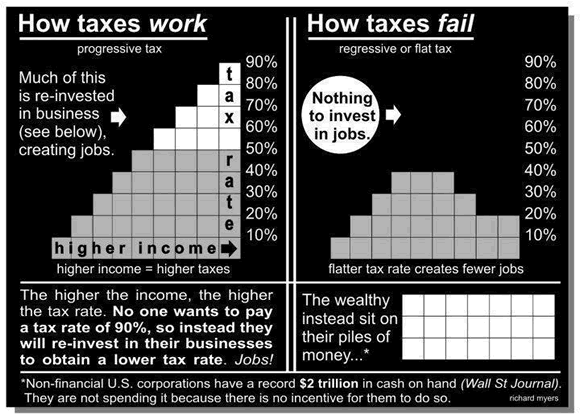
These lack of correlation between lower taxes and increased economic growth flies in the face of the assumptions of many. But upon a closer look, its easy to understand why higher taxes can actually encourage more investment in the economy.
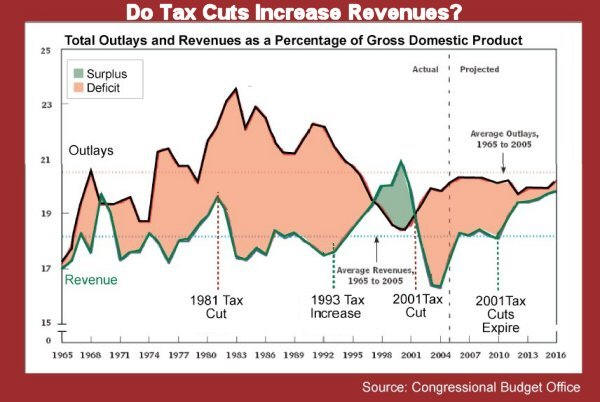
Do Tax Cuts Increase Revenues? No, Tax cuts do not Increase Revenue - Bush Tax Cuts & Reagan Tax Cuts - Facts | Fact and Myth
The plain fact is, revenue fell by $17 billion, or 2.8 percent, during fiscal year 1983, which was the first full fiscal year during which the 50 percent top federal income tax rate was in effect.
Furthermore, that drop came despite the fact that the recession of 1981-82 (when unemployment hit what is still a record 10.8 percent) was ravaging the economy during all of the previous fiscal year, and a recovery commenced two months after the start of FY 1983. (Fiscal years start Oct. 1 of the preceding calendar year.)
Normally, recoveries bring increases in revenues, not declines.
Rand Paul?s Supply-side Distortion
Q: Have tax cuts always resulted in higher tax revenues and more economic growth as many tax cut proponents claim?
A: No. In fact, economists say tax cuts do not spark enough growth to pay for themselves.
The Impact of Tax Cuts
This is not surprising given that no one in the Reagan administration ever claimed that his 1981 tax cut would pay for itself or that it did. Reagan economists Bill Niskanen and Martin Anderson have written extensively on this oft-repeated myth. Conservative economist Lawrence Lindsey made a thorough effort to calculate the feedback effect in his 1990 book, The Growth Experiment. He concluded that the behavioral and macroeconomic effects of the 1981 tax cut, resulting from both supply-side and demand-side effects, recouped about a third of the static revenue loss.
No, Gov. Pawlenty, Tax Cuts Don't Pay for Themselves | Stan Collender's Capital Gains and Games