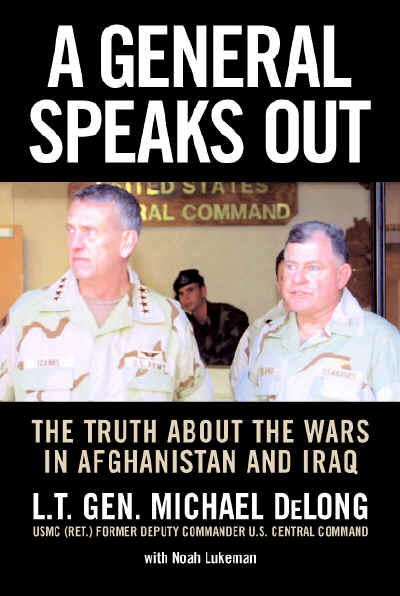
A General Speaks Out
EXCERPTS;
...
This source is three star General Mike DeLong, USMC, who was the #2 General at CENTCOM and General Tommy Franks’ right-hand man. From the bombing of the U.S.S Cole through the fall of Baghdad, General DeLong was an active participant in planning and executing the military response. General DeLong has also been one of the most active American visitors in Iraq since his retirement. General DeLong is also the only other high-ranking General to retire (aside from General Franks), and thus is in a position to offer more insider information than others.
A GENERAL SPEAKS OUT offers what other books cannot: a military overview of what really took place during this critical time period. It reveals the inner workings within the halls of power, where life-and-death decisions were made without the benefit of hindsight. Its story is one of a kind, its timing is unique, and DeLong tells it in a manner typical of a three-star general in the U.S. Marine Corps: directly, honestly and definitively.
A GENERAL SPEAKS OUT stands alone as the definitive military account of what occurred behind the scenes of our country at war.
...
“INSIDE CENTCOM is no partisan book. DeLong is no partisan; he’s been praised by both Franks (who has endorsed President Bush’s re-election) and retired Gen. Anthony Zinni, the retired CentCom commander (a leading critic of Bush.) In 240 pages, including a lengthy appendix, DeLong manages to pack in a number of eye-popping details – including where he thinks Osama bin Laden is hiding, why he believes the Chinese, Russians, Germans and French opposed the Iraqi war (substantial financial interests, which he details), and the quick transformation of the U.S. military into a speedy, flexible fighting force that coordinated its various branches as a single, cohesive team. He also writes that he came face-to-face with a jailed Chemical Ali, came to believe Iraq most definitely had WMD and says he believes he knows where they put them….INSIDE CENTCOM lives up to its title: it’s unvarnished, and it’s a deep look into the inner workings of the Central Command and America’s war-fighting apparatus. He not only talks about the successes of the quick, overwhelming military battles in Afghanistan and Iraq, but of the miscalculations and thorny political and diplomatic issues, as well….For anyone interested in the military’s war on terror, behind-the-scenes, “Inside CentCom” is essential reading.”
–LateFinal.com
...
“Lt. Gen. Mike DeLong was Gen. Tommy Franks’ right-hand man in conceiving and executing the Afghanistan and Iraq wars. While Franks was in the field, former Marine combat pilot DeLong ran Central Command (“CentCom”), the nerve center of both wars–where he was an active participant in discussions involving President Bush, Donald Rumsfeld, Paul Wolfowitz, Franks, George Tenet, and many others. Now, Gen. DeLong offers the frankest and most authoritative look inside the wars–how we prepared for battle, how we fought, how we toppled two regimes–and what’s happening now on these two crucial fronts. INSIDE CENTCOM takes you inside the center of American defense intelligence and war planning for the greater Middle East. You’ll go behind the scenes on the stealth operations leading up to the Afghan and Iraq wars, and then read the after-action report from today’s Iraq. You’ll also get authoritative answers to questions such as: Was President Bush really focused on Iraq from the start? Were we right to attack Iraq? What intel did we have on Saddam Hussein and his WMD? How did we plan and execute these wars?”
–Human Events online
...
“[Lieutenant General Michael DeLong] and General Franks are probably the most authoritative sources on the [Afghanistan and Iraq] wars. DeLong’s book is exactly what one would expect from a Marine – clear, concise, and to the point. There is no fluff, and no sugar-coating. DeLong calls it as he sees it, and his viewpoint is one well worth paying attention to. DeLong’s book is explosive in some aspects….DeLong also lays out the reasons for a lot of the post-liberation chaos, and does so with honesty….Ultimately, DeLong’s book….provides a superb first draft of history for the initial part of the war on terrorism, far more accurate than much of the media coverage.”
–Strategy Page, Harold C. Hutchison
...
“General DeLong served as the deputy commander of Central Command, directly under General Tommy Franks, for the first several years of the Global War on Terrorism. In Inside CentCom, he provides insider details on the military’s response to September 11th, confirming, for example, that Iraq was discussed by top officials in the immediate aftermath of the attacks. He also addresses the dynamic interaction between the CIA and Special Forces troops on the ground, explaining how they worked together in conjunction with indigenous Afghans to overthrow the Taliban. He provides behind-the-scenes looks at various events widely reported in the media, such as the rescue of Private Jessica Lynch, the decision to outlaw the Ba’ath Party, and President Bush’s famous carrier landing during which “Mission Accomplished” was proclaimed. Shedding new light on the planning and operations of both campaigns, such as the role of Special Forces in Iraq before the war started, DeLong argues that the invasion was fully justified and assures the reader that weapons of mass destruction will eventually be found. He is also highly critical of Iraqi exiles like Ahmad Chalabi. Proponents of multilateralism will appreciate his discussion of coalition-building, for which he was largely responsible, and his observation that the coalition against terrorism did not suffer from the diplomatic stresses of Iraqi Freedom.”
by Jack Greer , Staff Writer
The Stanford Review
...
GENERAL SPEAKS OUT: The truth about the wars in Afghanistan and Iraq (FORMERLY TITLED INSIDE CENTCOM) #1 Amazon “Afghanistan” Bestseller #2 Amazon “iraq” Bestseller * A Sel…

lukeman.com


 www.c-span.org