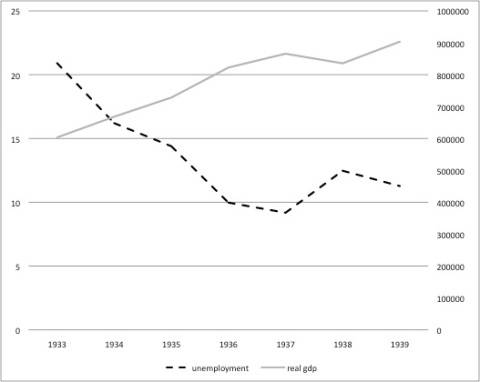
Powell Deserves an F in Economics, November 29, 2007
By watzizname "watzizname" (Murfreesboro, Tennessee) - See all my reviews
This review is from: FDR's Folly: How Roosevelt and His New Deal Prolonged the Great Depression (Paperback)
If Mr. Powell had submitted this as a paper in one of the college economics classes I taught, he would have received an F, for incompetent economic analysis and intellectual dishonesty. Mr. Powell picks his facts carefully, citing only those for which he can argue (almost always fallaciously) that FDR was wrong. Listing all his economic whoppers would become tiresome, but here are a few:
On page 41: "The fundamental fallacy in the high-wages doctrine was that it didn't increase the total purchasing power." BAD ECONOMIC ANALYSIS (BEA) Powell cleverly confuses instantaneous total purchasing power with total purchasing power over time. The same dollar (or $10, or $100) can make many times that many purchases over the period of a month or a year, with no change in the total instantaneous purchasing power. If Alice pays Brian $10 for something, Brian can spend that $10, as can those he pays it to, and so on. Economists call this the MULTIPLIER EFFECT, a term Powell never mentions.
The money is taxed every time it changes hands. The purchasing Power declines as value inflates.
On page 83, after admitting that only about 5% of Americans paid income tax during the Depression (carefully omitting that it was because wages weren't taxed) Powell says "these taxes surely discouraged employers from making investments." (BEA) Excess plant capacity and lack of demand, not taxes, were the major reasons for lack of investment. Even with zero taxes, who will invest in more plant capacity when their existing plant is operating at 20 or 25% of capacity and producing all the product they can sell?
Are you stating that sales are slack, the market is flooded and inventories are growing? Is there need? Is the product over priced? Is it a seasonal product? Could it possibly be that circumstance dictates what is affordable? I think that your claim of lack of demand is more related to priority spending and that is you that are being dishonest. The poor we're taxed when they spent, not when they earned. Powell clearly showed that. They starved for lack of Jobs, and means. FDR confiscated too much. He did not know when to stop.
On page 89: "Each dollar taxed meant a working person had a dollar less to spend on his or her own." INTELLECTUAL DISHONESTY (ID) Powell knew (he mentioned it on page 83) that wages weren't taxed.
Spending was taxed heavily. That is clearly shown. Why the disconnect?
On page 96: "(again, not counting jobs destroyed by taxes that reduced private sector spending)" (BEA) Powell makes much of the theoretical possibility, but never cites even one job destroyed by taxes. It is, of course, difficult to obtain an accurate count of those job losses that didn't happen, and Powell prefers to ignore the jobs created by the government spending of that tax money.
Only someone who could not turn a profit in a Kool-Aid stand could justify that argument. ... Well ... maybe I'm exaggerating a tiny tiny bit. How can you doubt the relationship, Theoretical Possibility, 
On page 41: "In any case, public works projects tended to require people with construction skills, so they weren't an effective way to help poor people" (BEA) Skilled workers were needed IN ADDITION TO, NOT INSTEAD OF common laborers, which generally outnumbered any of the skilled trades.
They Apprenticed, at least FDR built things, Obama is just pissing it away.
On page 161: "business investment remained at historic lows throughout the Great Depression." (ID) Production was increasing almost thruout FDR's presidency, but very little new investment was needed until the production facilities approached capacity.
For the life of me, I can't imagine why nobody wanted to invest. I'm gonna throw everything I have into Fannie and Freddie tomorrow.
On page 179: [Social Security] "supposedly would involve contributions by employers. In truth, the entire payroll tax would come out of the pockets of working people, because the tax would be part of the cost of providing a job; and if the money weren't going to the government, it would be available for employee compensation."
That's a gem right there. So the money that the Employer is paying into Social Security is not his either because we have imagined a use for it and usurped it, taking all credit for a resource born of extortion. Try being Self employed paying both ends of that tax, and take a good look in the mirror. (BEA & ID) Powell understandably does not specify which employers would actually have paid that money to employees, were it not for FICA {Social Security) tax. One suspects the list would be embarrassingly short.
You probably have never worked on merit or ability, so I can't fault you for not knowing any better. The embarrassment is taking what is not deserved, what has not been rightly earned.
On page 183: "The advocates of Social Security must have realized that private retirement plans would offer a better deal," (ID) No doubt they would have OFFERED a better deal, but experience (in Chile and England, for example) indicates that it is unlikely that they would have DELIVERED a better deal. And every laundry detergent cleans better than any of the others.
Some people will believe anything.
on page 254: [Social Security] is a pay-as-you-go system without an investment fund yielding returns to help cover future obligations." (ID) An out-and-out lie. SS is not fully advance funded, like the New York State Employees' Retirement System, but unlike pay-as-you-go, it does include an investment fund sufficient to meet ALL obligations for nearly four years and growing.
Paid for by the poorest, among us, so you can feel secure. (Source: OASDI Trustees Report, 2007)
On page 187: "Labor unions were generally based on force and violence . . . ." (ID) A blatantly unfair, untrue, and prejudicial statement. While it is true that a minority of unions descended to unjustified force or violence, most of the violence was started by company goons or strikebreakers. And calling elected union officers 'bosses' is similarly prejudicial and generally, false.
I feel like I need waist deep boots to comment on this. You are so full of shit. You actually teach shit like this to gullible kids? Shame on You.
On page 200: "General Motors car production plunged from 50,000 in December, 1935 fo 125 during the first week of February, 1936." (ID) Comparing dissimilar items, a month's production to a week's. This technique could have come straight from Darrell Huff's How to Lie With Statistics It would have been quite proper to say 'from an average of 12,500 a week in December,' but impressive as that 99% reduction is, Powell chose to make it seem four times as big. Not only dishonest, but downright silly.
Like unfunded mandates are silly, and expectations and demands with deadlines beyond Technilogical Capability? Comply or die? What the **** is the UAW gonna do now? They are Parasites, not producers.
On page 203: "UAW picketers fought with nonunion workers, and some people were stabbed." (ID) The 'some people' that were stabbed must have been union members, because had they been the strikebreakers, you can be sure Powell would have said so very clearly.
That is a real amazing deduction. Maybe I can use that reason to get disqualified from Jury Duty. Good foot work there.
On page 245: "Personal income tax rates hit 91 percent . . . ." (ID) Deceptively, Powell fails to mention that this was the highest tax bracket, not the average tax rate, which was nowhere near 91%.
Hammurabi and Moses had it at about 10% of wealth, not income, taxed every other year if I remember it right. When is enough, enough. You don't see the Jealousy here, the want, the greed from Government.
On page 273: "Maintaining wages above market levels is guaranteed to maintain unemployment at high levels." (BEA & ID) A 'guarantee' not worth the paper it is written on. Since the enactment of minimum wage laws, there have been many periods of full employment. The 'market levels' Powell envisions are the result of a monopsony market in which the sellers (workers) would be price-takers, forced to take whatever wages are offered or be unemployed and face starvation.
The Market sets the price. Not You not me Not Powell. Try selling something for more than it's worth, it's on you. By artificially corrupting the value of something, you screw up everything that is related to it. Everything it touches. Government needs to take off the God Hat and put the Referee hat back on.
On a lighter note, on page 226: "October 19, 1937--which came to be called 'Black Tuesday'" I googled "Black Tuesday" to be sure there weren't two, but all the entries referred to October 29, 1929.
The above is but a small sampling of the lies, distortions, and bad economic analysis in Mr. Powell's book. FDR did indeed do some bad things, such as the blatantly racist internment of American citizens of Japanese ancestry during WWII, and permitting the refusal to allow Jewish refugees from Germany to enter the United States, but he also did a great many more good things; the credit for bringing the nation out of the Great Depression is deservedly his, and Mr. Powell's mean-spirited hatchet job doesn't deserve even one star.