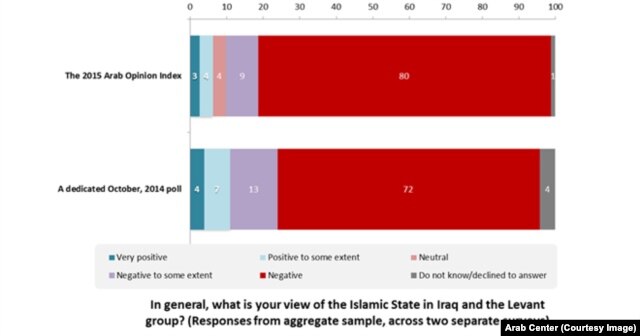
A new survey of more than 18,000 Arabs in 12 countries shows they overwhelmingly have negative views of Islamic State insurgents terrorizing many of their homelands. The Arab Center for Research and Policy Studies in Doha, Qatar, said it found that 80 percent of the people surveyed in face-to-face interviews throughout the Mideast expressed negative views about the Islamic State group that has proclaimed a caliphate through large swaths of Iraq and Syria. Another 9 percent said they viewed the group negatively "to some extent." The center's fourth annual Arab Opinion Index says about 1,500 people – half men and half women – were interviewed in each of the countries between May and September this year, in part to gauge sentiment about the jihadist group and the nearly five-year civil war in Syria.
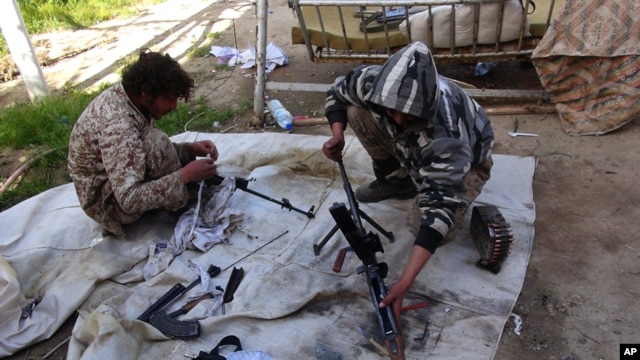
Islamic State militants clean their weapons in Deir el-Zour city, Syria, in this image published on an anonymous photo-sharing website in June. An Arab Center survey shows widespread opposition to the group in the Mideast.
The survey results "show no significant correlation between support for ISIL and religiosity," researchers explained on the center’s website, using an acronym for the militant group. "Favorable views of ISIL are equally prevalent among respondents who are 'very religious' and those who are 'not religious,' and also equally prevalent amongst opponents and supporters of the separation of religion from the state," they wrote. "In other words, support for radical extremist organizations in the Arab world, where it exists, is rooted in political grievances within the Arab region and its conflicts, and not a religious ideology."
Arab Center survey shows opposition to Islamic State militants has increased.
Researchers said the overall negative sentiments against Islamic State militants ran highest in Lebanon (99 percent), Jordan and Iraq (97 percent), Tunisia (96 percent), Saudi Arabia (95 percent) and Kuwait (90 percent). The survey showed weaker, but still negative, views toward IS militants in Mauritania (74 percent), Algeria and Morocco (both 83 percent), Egypt and Sudan (both 84 percent) and the Palestinian territories (87 percent).
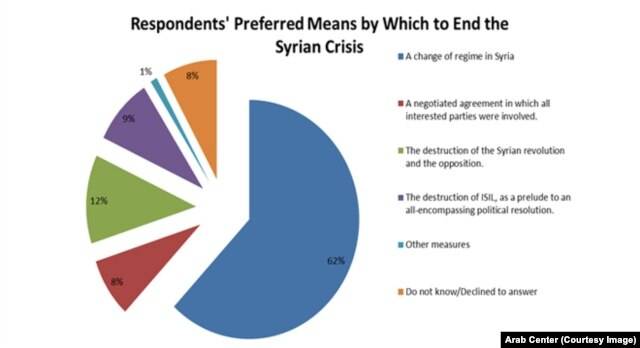
Almost two-thirds of survey respondents want to see regime change as a way to resolve the crisis in Syria.
The survey showed 20 percent of people in Mauritania with positive to very positive views of the Islamic State, while people in Iraq, Jordan, Tunisia and Saudi Arabia all showed the least positive, at 2 percent. Khalil Jahshan, executive director of the Arab Center in Washington, said researchers interviewed roughly equal numbers of people in each of the countries so the results would reflect views throughout the region, not just in the biggest countries: Egypt, Iraq, Saudi Arabia, Algeria, Morocco and Sudan.
'Sectarian tensions'