Censorship returns to the CDC. At least 22 webpages are down

C_Clayton_Jones

Diamond Member
Joined
Apr 28, 2011
Messages
82,027
Reaction score
45,721
Points
2,605
Location
In a Republic, actually
“Censorship is back at the CDC, Inside Medicine has learned. A new table provided by an active agency employee listed nearly two dozen webpages that are now offline. Many of the 22 removed sites appear to have been taken down recently, having been online as recently as earlier this month, an Inside Medicine analysis revealed. Some of the removed sites may have been removed within the last few days, while others may have been offline for far longer, but flew under the radar. In some cases, agency staffers have been specifically instructed to remove websites, I was told. Others were discovered by employees in the course of their work, such as a seemingly random RSV surveillance page which is now offline.
[…]
As you can see, many, if not most, of the removed pages have obvious tie-ins to topics known to be disfavored by the Trump administration, including some on the care of LGBTQ+ people, health equity issues related to a variety of diseases or disabilities, sexually transmitted infections, and related educational resources.”
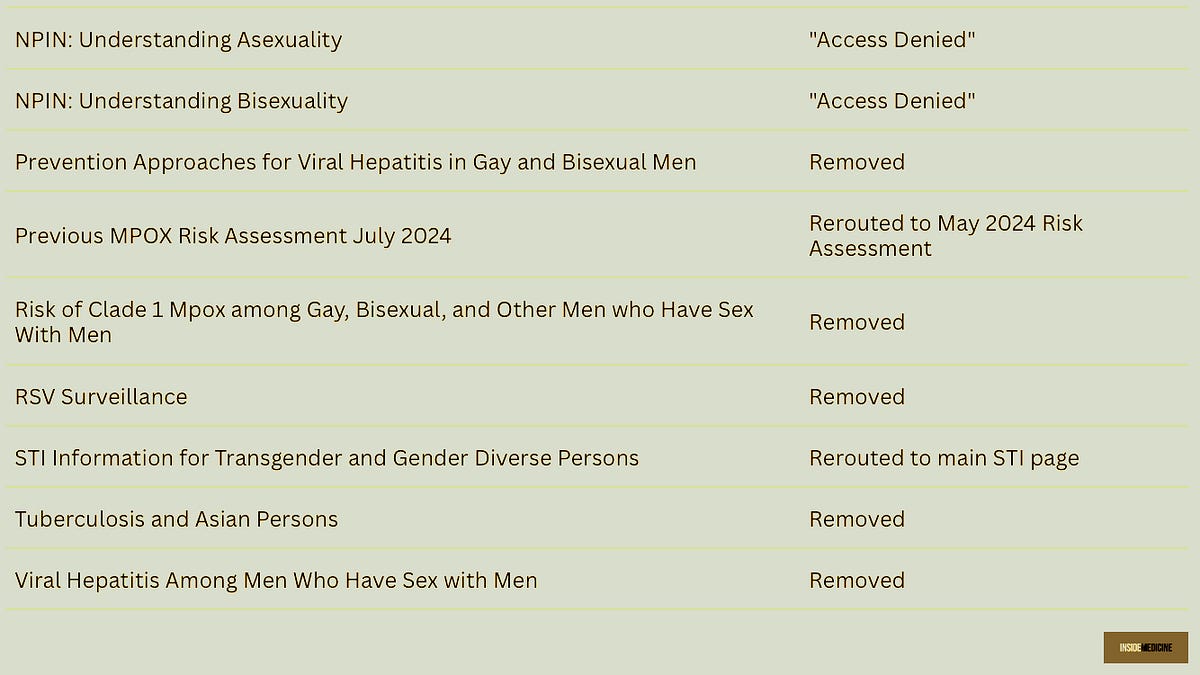

Censorship motivated by the Trump regime’s bigotry and hate directed at LGBTQ+ Americans.
 
“Censorship is back at the CDC, Inside Medicine has learned. A new table provided by an active agency employee listed nearly two dozen webpages that are now offline. Many of the 22 removed sites appear to have been taken down recently, having been online as recently as earlier this month, an Inside Medicine analysis revealed. Some of the removed sites may have been removed within the last few days, while others may have been offline for far longer, but flew under the radar. In some cases, agency staffers have been specifically instructed to remove websites, I was told. Others were discovered by employees in the course of their work, such as a seemingly random RSV surveillance page which is now offline.
[…]
As you can see, many, if not most, of the removed pages have obvious tie-ins to topics known to be disfavored by the Trump administration, including some on the care of LGBTQ+ people, health equity issues related to a variety of diseases or disabilities, sexually transmitted infections, and related educational resources.”


Censorship motivated by the Trump regime’s bigotry and hate directed at LGBTQ+ Americans.
Thats not censorship thats controlling information thats bogus and destructive
 
The politics of medicine
 
Trust the science.
40% of all science is invalid

Summary​

There is increasing concern that most current published research findings are false. The probability that a research claim is true may depend on study power and bias, the number of other studies on the same question, and, importantly, the ratio of true to no relationships among the relationships probed in each scientific field. In this framework, a research finding is less likely to be true when the studies conducted in a field are smaller; when effect sizes are smaller; when there is a greater number and lesser preselection of tested relationships; where there is greater flexibility in designs, definitions, outcomes, and analytical modes; when there is greater financial and other interest and prejudice; and when more teams are involved in a scientific field in chase of statistical significance. Simulations show that for most study designs and settings, it is more likely for a research claim to be false than true. Moreover, for many current scientific fields, claimed research findings may often be simply accurate measures of the prevailing bias. In this essay, I discuss the implications of these problems for the conduct and interpretation of research.


Published research findings are sometimes refuted by subsequent evidence, says Ioannidis, with ensuing confusion and disappointment.


Published research findings are sometimes refuted by subsequent evidence, with ensuing confusion and disappointment. Refutation and controversy is seen across the range of research designs, from clinical trials and traditional epidemiological studies [1–3] to the most modern molecular research [4,5]. There is increasing concern that in modern research, false findings may be the majority or even the vast majority of published research claims [6–8]. However, this should not be surprising. It can be proven that most claimed research findings are false. Here I will examine the key factors that influence this problem and some corollaries thereof.
 
40% of all science is invalid

Summary​

There is increasing concern that most current published research findings are false. The probability that a research claim is true may depend on study power and bias, the number of other studies on the same question, and, importantly, the ratio of true to no relationships among the relationships probed in each scientific field. In this framework, a research finding is less likely to be true when the studies conducted in a field are smaller; when effect sizes are smaller; when there is a greater number and lesser preselection of tested relationships; where there is greater flexibility in designs, definitions, outcomes, and analytical modes; when there is greater financial and other interest and prejudice; and when more teams are involved in a scientific field in chase of statistical significance. Simulations show that for most study designs and settings, it is more likely for a research claim to be false than true. Moreover, for many current scientific fields, claimed research findings may often be simply accurate measures of the prevailing bias. In this essay, I discuss the implications of these problems for the conduct and interpretation of research.


Published research findings are sometimes refuted by subsequent evidence, says Ioannidis, with ensuing confusion and disappointment.


Published research findings are sometimes refuted by subsequent evidence, with ensuing confusion and disappointment. Refutation and controversy is seen across the range of research designs, from clinical trials and traditional epidemiological studies [1–3] to the most modern molecular research [4,5]. There is increasing concern that in modern research, false findings may be the majority or even the vast majority of published research claims [6–8]. However, this should not be surprising. It can be proven that most claimed research findings are false. Here I will examine the key factors that influence this problem and some corollaries thereof.
I'm just repeating what we were told to do repeatedly during 2020 despite how nonsensical it was.
 

New Topics

Latest Discussions

Back
Top Bottom