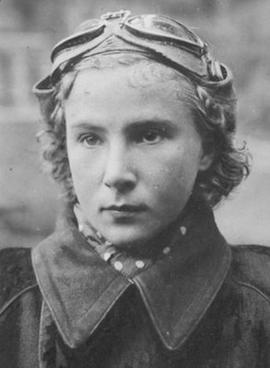
There was plenty of women fighter-pilots in Russia.
Before the war, hundreds of girls studied flying in the flying clubs of OSOAVIAKHIM. In early October 1941, the famous pilot, Hero of the Soviet Union, Marina Raskova appealed to the Central Committee of the CPSU (b) with a request to allow her to create a women's aviation regiment. There were so many willing that it was decided to form not one, but three women's aviation regiments: the 586th Fighter, 587th Bomber and 588th night light bomber. The 586th IAP was formed on December 9, 1941. It included the first 25 girls who passed the rigorous exam. On January 28, 1942, the regiment began receiving Yak-7 fighters, and then Yak-1. The training showed a fairly high level of training of the pilots.
On February 23, 1942, the regiment carried out its first combat mission to cover the bridge over the Volga. For a long time, the pilots of the 586th regiment failed to shoot down a single enemy aircraft. Finally, on the night of September 24, 1942, the deputy commander of the squadron, Lieutenant V. D. Khomyakova, won the first aerial victory of the "women's" 586th regiment, shooting down a Junker Ju 88. Later, the 586th IAP covered the rear facilities of Saratov, Voronezh, Kursk, Kiev and other cities.
In September 1942, Lydia Litvyak, Raisa Belyaeva, Ekaterina Budanova, Maria Kuznetsova, Claudia Nechaeva, Antonina Lebedeva, Claudia Blinova and Olga Shakhova, at their urgent request, were transferred from the rear 586th regiment to the 437th and arrived at the front near Stalingrad. Fearing that they might die in the first combats, the command attached both units of the 1st squadron to the most powerful fighter regiments operating at Stalingrad at that time. Raisa Belyaeva's unit got into the 437th IAP, and Claudia Nechaeva's unit landed on September 13, 1942 at the Stalingradsky state farm, where the already famous 434th aviation regiment was based.
So, replenishment arrived in 434 iap: flight commander Lieutenant Klava Nechaeva, senior Sergeant Klava Blinova, second Lieutenant Olya Shakhova and Theirs LieutenantTonya Lebedeva. The link was serviced by mechanics, technician-Lieutenant V.I. Stukalin, sergeants Z.A. Malkova, A.M. Shakhova, A.A. Eskina, and senior sergeant V.M. Skachkova, parachute stackers, junior sergeants E.A. Terekhova, M.M. Makarova, aviation armament mechanics, privates M.D. Shcherbatyuk and T.S. Gubareva. The girls were seconded to the regiment by order of the commander of the Air Force, Lieutenant General A.A. Novikov. They were greeted unkindly. The commander of the regiment, Major Kleshchev, spoke frankly about the incoming replenishment: "It hurts me to see a woman in the war. It is painful and shameful-as if we men cannot protect you from this unladylike business. You'll may also cry." The squadron commanders did not want to take on this replenishment.
Here is how A. Semenov, who was seconded to the regiment from the Air Force Inspection, spoke after a comprehensive check of the level of training of the newly arrived girls' replenishment: "Frankly, at first the regiment's command was not happy with such a replenishment. They were afraid that the girls would distract some part of the men from their military affairs. But it turned out the opposite, the men only tightened up even more and behaved quite chivalrously. This was largely facilitated by the modest, dignified behavior of the girls themselves. The pilots were well trained in piloting a fighter, taking off and landing. But their preparation for combat operations suffered from serious drawbacks. They did not know how to conduct air combat tactically competently, maneuver vertically, and use weapons effectively. They still had to be taught and taught this. I could not imagine how they would fight in such a difficult air situation as that at Stalingrad. No matter what is said about gender equality, a man is a man: he is hardy, determined, unpretentious in everyday life. And to put it bluntly, his whole masculine nature was created to fight, to overcome difficulties. And the girls? Yes, it's just a human pity to send them into battle..."
The female pilots were assigned to squadrons, and experienced combat pilots became their mentors. The regiment's command began the introduction of a new replenishment by instructing them to escort transport aircraft, intercept enemy reconnaissance aircraft, and be on duty over the airfield. But the girls were offended by this and when visiting the Commander of the Air Force of the RA, Lieutenant General A.A. Novikov and the commander of the 16th VA, General S.I. Rudenko, they asked them to allow them to air battles. After listening to the arguments of the regiment's command, the commander noted that Kleshchev was doing the right thing, but, given the patriotism of young people, they should more often be led by experienced fighters.
And here's how Andrei Baklan recalled Lebedeva's Tonya: "Sometimes Tonya Lebedeva was my wingman in a frontline situation. You can look at her on earth-a small, fragile girl. And in the air, I would never have thought that there was a "weaker sex" nearby. More often than not, I forgot about it. Tonya piloted confidently. She followed my instructions clearly and in a timely manner. And only then did you remember who your wingman was, when you would hear a thin, excited voice on the radio warning of danger. Well, for example: "The skinny ones are up from us!". After completing the combat mission, Tonya will come up to me in a flight suit and a headset, which does not prevent her from turning into a teenage girl again, salute with her miniature hand and ask with hidden anxiety:
- Let me get some comments!
And what comments can there be? I answer with complete sincerity, without any stretch:
- Great! Keep it up !
Frankly speaking, the regiment's command protected the pilots. Of course, to the extent that it was even possible in the war. We tried not to send the "weaker sex" on obviously risky tasks. Well, the girls themselves were so eager to meet the dangers..."
View attachment 965697