the anti-Jewish boycott campaign begun by Adolf Hitler on April 1, 1933
Actually, in 1933:
Sure, Nazi Louie. Always leave out the important details about history:
On March 20, 1933, efforts got under way in both Poland and the United States to initiate economic boycotts of Nazi Germany. Within several years, boycott movements had been started by Jewish communities – although they were not limited to them – in a number of countries around the world.
Violence against Germany’s Jews began right after the Reichstag election of March 5, 1933, when a Nazi victory allowed Adolf Hitler, who had become chancellor on January 30, to consolidate his power. Various organs of the National Socialist party undertook to harass Jews across the country – boycotting their businesses, attacking presumed Jews in the streets, even breaking into and searching Jews’ homes.
News of the abuse quickly spread around the world, and Jewish organizations appealed to the new German government to come down hard on those who were doing the attacking. The response of Hermann Goering that, “I shall employ the police, and without mercy, wherever German people are hurt, but I refuse to turn the police into a guard for Jewish stores,” was a typical response, as well a harbinger of things to come.
read more: This day in Jewish history / Jews start boycott of Nazi Germany
Nazi Louie? Great start there, but what's a "Nazi Louie?" Are you trying to hurt me because I am Jewish, but not a zionist?
Always leave out the important details about history?
With all due respect, I am more than happy to discuss this history as I have studied it previously. Make no mistake, The London press on March 24, 1933 reported under the headline
"Judea Declares War on Germany - Jews of All the World Unite - Boycott of German Goods - Mass Demonstrations," they spoke of a
"Holy War" and implored Jews around the world to boycott German goods and businesses, and to also engage in mass demonstrations. They further reported that this boycott had already begun and just three days later, the front page of the NY Daily News on March 27, 1933 read:
They were off and running and a few months later, Samuel Untermyer made a speech on August 6, 1933 that was broadcast live (and was reprinted in the NY Times the following morning). He spoke literally of
"the holy war in the cause of humanity in which we are embarked."
He continues:
"It is a war that must be waged unremittingly until the black clouds of bigotry, race hatred and fanaticism {similar to Israel today?}
that have descended upon what was once Germany {Palestine?}, but is now medieval Hitlerland {Nutenyahuland?}, have been dispersed."
It is important to know that Hitler was STILL not yet Germany's leader at this time. He was leading the The National Socialist German Workers' Party (Nazi).
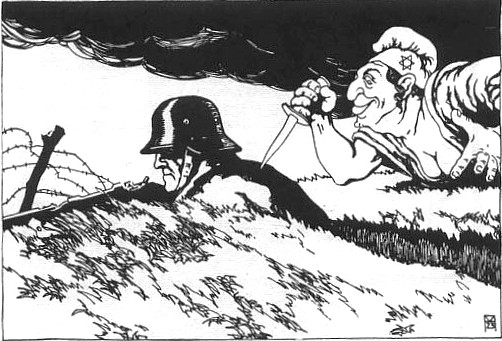
But, let's back up for a second. Antisemitism in Germany (and Europe in general) was already high. Many Germans and others blamed the Jews for their fate in WW1. An example would be this Austrian postcard from 1919:
Hitler was definitely influenced by this and as used this common belief as part of his propaganda which led to overwhelming support for the Nazi party. Then, with the depression, more anti-Jewish propaganda became widespread that blamed the Jewish bankers for the economic horrors. Germans were watching their wives, their children, their parents, literally starving to death. This has to be understood. Hitler seized on this as well. He was leading the Nazi party to new heights at this time, a party he took from basically a few hundred people when he got out of prison, to millions. He was amazingly popular among the people at this time and his popularity was still rising. For example:
In the elections of September 1930 the Nazis polled almost 6.5 million votes and increased their parliamentary representation from 12 to 107. In the presidential elections of the spring of 1932, Hitler ran an impressive second to the popular World War I hero Field Marshal Paul von Hindenburg, and in July he outpolled all other parties with some 14 million votes and 230 seats in the Reichstag (parliament).
Adolf Hitler facts, information, pictures | Encyclopedia.com articles about Adolf Hitler
In short, the German people felt like the Jews had declared war upon them from the moment that the "Holy War" declaration was made public.


 ]
]