BellaJones
Rookie
- Nov 19, 2025
- 26
- 24
- 1
I’ve been diving into the recent filings to see where the "Smart Money" is hiding, and the action around UnitedHealth (UNH) is a perfect case study in data-driven investing.
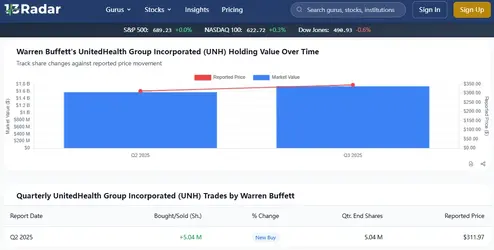
When Warren Buffett buys UNH started trending in the value investing circles earlier, it wasn't just about following a name—it was about understanding the institutional accumulation. If you look at the raw data from the 13F filings (I’ve been using 13Radar to visualize these trends), you can see a fascinating divergence between short-term sentiment and long-term conviction.
For instance, while retail sentiment was bearish due to MCR (Medical Care Ratio) pressures, the institutional ownership trends showed a steady "toe-hold" accumulation by Berkshire and several other insurance-focused whales. By analyzing their valuation metrics alongside these buys, it becomes clear that the pros were eyeing UNH when its P/E dropped significantly below its 5-year historical average—a classic value play.
How these datasets help us judge:
What about you guys? When you're tracking big moves like Buffett's, what's your go-to for raw filing data or visualization? Do you rely more on the 13F filings, or do you prioritize real-time social sentiment?
Curious to hear how you separate the signal from the noise.
When Warren Buffett buys UNH started trending in the value investing circles earlier, it wasn't just about following a name—it was about understanding the institutional accumulation. If you look at the raw data from the 13F filings (I’ve been using 13Radar to visualize these trends), you can see a fascinating divergence between short-term sentiment and long-term conviction.
For instance, while retail sentiment was bearish due to MCR (Medical Care Ratio) pressures, the institutional ownership trends showed a steady "toe-hold" accumulation by Berkshire and several other insurance-focused whales. By analyzing their valuation metrics alongside these buys, it becomes clear that the pros were eyeing UNH when its P/E dropped significantly below its 5-year historical average—a classic value play.
How these datasets help us judge:
- Institutional Trend: Seeing a "cluster" of gurus buying the same sector often validates a bottom better than any technical chart.
- Financial Metrics vs. Price: When the stock price dips but the cash flow per share remains robust on the 13F summaries, it signals a temporary "noise" rather than a fundamental break.
What about you guys? When you're tracking big moves like Buffett's, what's your go-to for raw filing data or visualization? Do you rely more on the 13F filings, or do you prioritize real-time social sentiment?
Curious to hear how you separate the signal from the noise.