What If We ARE Alone?

And as fast as it developed on Earth, I believe it did.

In the last five decades, I have seen the "origin of life" on Earth pushed back hundreds of millions of years. In the early 1970s, the consensus was that it started around 3.5 gya. Far before the 3.9-4.2 gy that it is today. Of course, that was also before the discovery of the extremophiles at deep sea vent locations and in many in deep caves where the environment is not all that different from what it would have been like on the surface some 3 gya.

Insane pressures, and surviving not on photosynthesis but off of the chemicals in the environment that are deadly to anything living on or near the surface today.

More than anything else, the discoveries of those creatures as well as recognizing some very early "microbial mats" in Australia as actually being fossils pushed back the timeline around a half a billion years.

And it is also possible that there was life on "Earth Mark I", before Theia crashed into it. It was about at the age after it was created that we are seeing signs of life on "Earth Mark II". Around 300-500 million years. But much of the surface of the planet in the collision was basically blown off, and most of it now makes up our moon.

And in the last decade I have been watching closely as more and more evidence that the core of Theia is in the mantle of our planet in the form of LLSVPs. Large "blobs" resting deep in the mantle do not match the actual core of our planet itself.

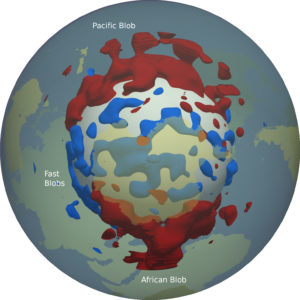
Blog_3D_picture-300x300.jpg
Yes, I saw that about Theia, too. Good stuff. Damn we're good.
 
Not wild enough to eradicate all life
Most planets can’t say that

Not all life, just 99.99999% of life.

As I said, the largest mass extinction in the history of the planet was caused by life itself. Which caused almost every other life form on the planet to die.
 
And I am skeptical of your claim. What climate swings on Mars? Europa?

Well, we know Mars did have some radical changes. But all down, from a molten surface to a wet surface, to a dry barren surface. Only capable of supporting life for a brief point in the middle.

Europa, we just do not know. Lots of speculation, but until we can get a probe there that is all that it is, speculation. But it is possible.
 
Here are some thoughts about the STATISTICAL likelihood of life existing outside of Earth. It seems to me that we may be looking through the wrong end of a telescope by presuming that because life exists on Earth, it MUST exist elsewhere in the universe. What if it doesn't?

One way to look at this question is through statistical sampling. Let's hypothesize that there are 10 billion data points in the universe. Let's also take a random sample of a billion of these data points in order to determine the probability of life in the universe. A sample of this size is certainly enough to provide a confidence level of near certainty regarding its results. What if no life was detected in this sample? Wouldn't this lead us to conclude that there is no life in the universe?

Another way to look at this question is through probability calculations. A well-known equation is often used to assign probabilities to a finite number of conditions presumed to be necessary for life to exist and then essentially multiply them by infinity to produce a foregone conclusion of life existing elsewhere. However, since infinity is NOT a number, the universe can not contain an infinite number of data points. As a result, these calculations are based on a type of circular logic.

In addition, all of the conditions necessary for the creation of life are not known. But even if they were, the probability of them simultaneously occurring at the same time and place may be extremely small. Even without the time element, if there were 100,000 of these conditions with each having a one in a 100,000 probability of existing, there would be less than a 50% probability of them all occurring more than once.

Maybe we ARE all alone in the universe.
This seems some shoddy statistical analysis. I would suggest 3 starting data points.

-We know live exists in at least one place in the universe.

-We know thaf life started the moment conditions to sustain it made it possible. On a geological time-scale.


-We know the basic amino acids that are the building blocks of life are found across the universe.

If we then consider the amount of planets in the universe it becomes statiscally improbable that Earth is unique.
 
Both, though Pond Scum is most likely

A planet must maintain temperatures in a relatively small range (liquid water) and avoid wild climate swings which would wipe out emerging life.
Avoiding a major climate event is essential to evolving advanced life forms
My question is how do you know what conditions life requires to emerge and sustain itself?

Scientists have a sample size of one planet capable of sustaining life.. earth. So we know what conditions are required here. With the caveat that we only have the archeoligical and current biological evidence to go by.

Nothing I know off excludes the possibilty of life emerging under different conditions elsewhere. Liquid water is important for life here, as we know it. Drawing further definitive conclusions beyond that is premature at best.
 
Last edited:
Care to give anything other than a vague non-claim?
Ranging from 10 to the 22th power and 10 to the 24th power. Going by one exoplanet per star system. An estimate you can base on the seeming abundancy of exoplanets being discovered currently and one that makes the 1 on one ratio I'm suggesting a conservative one.

Since we know the chance life existing is not zero. It becomes improbable earth is unique.

Because there's no condition on Earth that seems especially outlandish. We know of planets with a magnetic field. Planets with liquid water, planets in the Goldilocks zone. Planets with moons. And as I said the amino acids that build life here are abundant.
 
Last edited:
My question is how do you know what conditions life requires to emerge and sustain itself?

Scientists have a sample size of one planet capable of sustaining life.. earth. So we know what conditions are required here. With the caveat that we only have the archeoligical and current biological evidence to go by.

Nothing I know off excludes the possibilty of life emerging under different conditions elsewhere. Liquid water is important for life here, as we know it. Drawing further definitive conclusions beyond that is premature at best.

Every planet has to use the same Periodic Table of Elements and Laws of Physics that we do.
Simple compounds like H2O and CO2 formed by elements of low atomic mass are most easily formed.
The laws of physics also apply regarding space travel, time and distance
 
Every planet has to use the same Periodic Table of Elements and Laws of Physics that we do.
Simple compounds like H2O and CO2 formed by elements of low atomic mass are most easily formed.
The laws of physics also apply regarding space travel, time and distance
Sure, but scientist have theorized about many other possibilities including those lifeforms that would thrive in what we would consider hostile.
envirements.

In fact, the first big extinction event on this planet was when oxygen concentrations went up. It was a poisonous gas for early life. This belies the fact that Earth sustained life because of no big climate swings since this cooled the planet in what is now known as snowball earth.

My point is. Life is both incredibly resilient and diverse and that's the only reliable conclusion we can make.
 
15th post
In fact, the first big extinction event on this planet was when oxygen concentrations went up. It was a poisonous gas for early life. This belies the fact that Earth sustained life because of no big climate swings since this cooled the planet in what is now known as snowball earth.

In fact, those of us using the most grounded science to make our cases are not saying that at all. Hell, the fact we are in a cold interglacial in a three million year old ice age kinda shows that is not accurate.

There have been a hell of a lot of "big climate swings", that is simply the most extreme, and next to The Great Oxidation Event the most visible in the geological record. In addition they were the largest to see that were truly "planetary wide" events.

I can also throw in the multiple megacontinents, the multiple asteroid impacts like KT, and many more.
 
We are alone

If you exist on a planet without a chance of contacting other life forms, you are alone

If you are lost in the woods with nobody around you for hundreds of miles, you are alone
 
Back
Top Bottom