States now are the check on presidential overreach

C_Clayton_Jones

Diamond Member
Joined
Apr 28, 2011
Messages
81,999
Reaction score
45,653
Points
2,605
Location
In a Republic, actually
‘Thank goodness for state governments. One of the most underappreciated stories in 2025 was the role states played in checking federal overreach. As the Trump administration barreled through norms, rules and laws, state officials — sometimes from both parties — supplied the friction to slow the administration’s power grab.

Trump swept into power with Republican control over both chambers of Congress, but he avoided working with Congress as much as possible. He spent the first year of his second term pushing the bounds of executive power. As his Chief of Staff Susie Wiles told a Vanity Fair journalist: Trump “operates [with] a view that there’s nothing he can’t do. Nothing, zero, nothing.”

Congress may have rolled over, but at the state level, things played out pretty much the way America’s founders intended. As James Madison wrote in Federalist No. 45: “The powers delegated by the proposed Constitution to the federal government are few and defined. Those which are to remain in the State governments are numerous and indefinite.”

Madison and his fellow visionaries settled upon a system that enshrined in the U.S. Constitution the legal authority for states to protect the freedoms of their residents and uphold the rule of law when the federal government abused its power.


Democratic states supplied the friction to slow the Trump regime’s power grab; Republican opposition was rare.

Indeed, it was red states that rolled over along with a feckless Republican Congress.

And again, the hypocrisy of Republicans was on full display, supposed advocates of states’ rights, Republicans who did nothing to oppose a Republican president’s attack on the states, Republicans who cheered Trump’s attacks on Democratic states.
 
‘Thank goodness for state governments. One of the most underappreciated stories in 2025 was the role states played in checking federal overreach. As the Trump administration barreled through norms, rules and laws, state officials — sometimes from both parties — supplied the friction to slow the administration’s power grab.

Trump swept into power with Republican control over both chambers of Congress, but he avoided working with Congress as much as possible. He spent the first year of his second term pushing the bounds of executive power. As his Chief of Staff Susie Wiles told a Vanity Fair journalist: Trump “operates [with] a view that there’s nothing he can’t do. Nothing, zero, nothing.”

Congress may have rolled over, but at the state level, things played out pretty much the way America’s founders intended. As James Madison wrote in Federalist No. 45: “The powers delegated by the proposed Constitution to the federal government are few and defined. Those which are to remain in the State governments are numerous and indefinite.”

Madison and his fellow visionaries settled upon a system that enshrined in the U.S. Constitution the legal authority for states to protect the freedoms of their residents and uphold the rule of law when the federal government abused its power.


Democratic states supplied the friction to slow the Trump regime’s power grab; Republican opposition was rare.

Indeed, it was red states that rolled over along with a feckless Republican Congress.

And again, the hypocrisy of Republicans was on full display, supposed advocates of states’ rights, Republicans who did nothing to oppose a Republican president’s attack on the states, Republicans who cheered Trump’s attacks on Democratic states.
So your ok with States ignoring federal gun laws?
 
‘Thank goodness for state governments. One of the most underappreciated stories in 2025 was the role states played in checking federal overreach. As the Trump administration barreled through norms, rules and laws, state officials — sometimes from both parties — supplied the friction to slow the administration’s power grab.

Trump swept into power with Republican control over both chambers of Congress, but he avoided working with Congress as much as possible. He spent the first year of his second term pushing the bounds of executive power. As his Chief of Staff Susie Wiles told a Vanity Fair journalist: Trump “operates [with] a view that there’s nothing he can’t do. Nothing, zero, nothing.”

Congress may have rolled over, but at the state level, things played out pretty much the way America’s founders intended. As James Madison wrote in Federalist No. 45: “The powers delegated by the proposed Constitution to the federal government are few and defined. Those which are to remain in the State governments are numerous and indefinite.”

Madison and his fellow visionaries settled upon a system that enshrined in the U.S. Constitution the legal authority for states to protect the freedoms of their residents and uphold the rule of law when the federal government abused its power.


Democratic states supplied the friction to slow the Trump regime’s power grab; Republican opposition was rare.

Indeed, it was red states that rolled over along with a feckless Republican Congress.

And again, the hypocrisy of Republicans was on full display, supposed advocates of states’ rights, Republicans who did nothing to oppose a Republican president’s attack on the states, Republicans who cheered Trump’s attacks on Democratic states.
This article would have been great in the 1700's
 
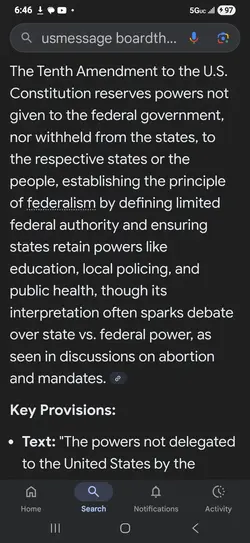
Okay let's start here.
This is the bookend to free speech.
50 little brash countries, still are.

This is the tenth reason why USA has survived
 

Attachments

  • Screenshot_20260117_184611_Google.webp
    Screenshot_20260117_184611_Google.webp
    94 KB · Views: 7
Really, so the NFA or Hughes Amendment don’t exist?
That's pretty specific.
I believe state law fundamentally transcends
federal, notwithstanding machine guns, grenades. certain others types.
It's rooted in the constitution. Vermont & Florida both have minimal restriction, states can add to or remove, which is also in the bill of rights.
 
That's pretty specific.
I believe state law fundamentally transcends
federal, notwithstanding machine guns, grenades. certain others types.
It's rooted in the constitution. Vermont & Florida both have minimal restriction, states can add to or remove, which is also in the bill of rights.
Yes or no, do those laws exist?
 
15th post
Yes or no, do those laws exist?
Well no,
They're not laws, more like guidelines.
When you see "the language"
It's usually that.
The legislation is specific to new full auto machine guns mac 10's etc.
Day to day gun law really has no restrictions in my home states of vt dc & florida.
D.C. obviously is different with conceal carry.
But not for me.
Then there's class three license (wardogs).
 
He presides over the entire USA. One state does not preside over him. More lib loon wishfullness presented as fact
 
He presides over the entire USA. One state does not preside over him. More lib loon wishfullness presented as fact
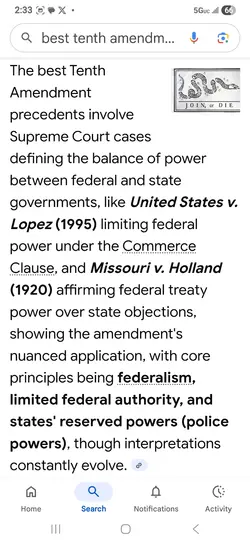
This is where the breakdown occurs in my mind.
United states was never meant to be one big , fat , small handed pig
headed country.
We are states.
This is the genius of our document.
No one presides or runs our country,
because no one has needed to.
Since 1750's or so.
really 300 years. This is where our best design became Americans' stillwater runs deep.
 

Attachments

  • Screenshot_20260119_143335_Google.webp
    Screenshot_20260119_143335_Google.webp
    104.1 KB · Views: 7
Back
Top Bottom