Quantitative versus qualitative change

Wise47

VIP Member
Joined
Jun 9, 2019
Messages
509
Reaction score
41
Points
76
Location
Poland
HJwXvKoc_o.gif


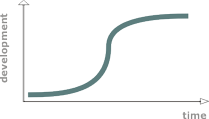
diagram. Logistic development


Logistic development (see diagram and for example my text Sociological theory) can explain a difference between a qualitative change and quantitative change. It shows that each kind of so called qualitative change, like for example liquefaction of gas, is just some form of quantitative change. Marxists are using conception of change where quantitative changes transform to qualitative change. But this idea is containing fundamental mistake that there is a difference between qualitative and quantitative change.
What I would like to emphasize is each so called qualitative change, for example the transition of water into ice, or steam into water, is actually a cumulative quantitative change; that is, a quantitative change taking place quickly over a short period of time. So there are no qualitative changes, only quantitative ones (the above part of this paragraph is from year 2008).
The second law of Marx's dialectics is the law of the transformation of quantity into quality. If, for example, we gradually heat water by one degree, at some point it will turn into steam, and this is a qualitative, not quantitative, change. As my analysis shows, this law is incorrect. In fact, this transformation of water into steam is also a quantitative change, only a very rapid one, occurring suddenly through a quantitative leap. Let's look again at diagram (the above part of this paragraph is from year 2025).


Gregory Podgorniak, Poland


about the author, My name is Gregory Podgorniak (brn. 01.1977, Szczecinek, West Pomerania, Poland). I am working on field of natural as well as social sciences. During philosophical studies at Adam Mickiewicz University in Poznan (1996-1999) I was actively act in student scientific organisation, got a scientific scholarship, and one from my articles titled Circulus vitiosus and fourfold petitio principii in the system of Descartes was published in Humanistic Drafts of Publishing House of Humaniora Foundation in Poznan, no. 6, 1998. Unfortunately certain fate events made impossible to me continuing studies to master's and later doctor's degree. Thence I was forced to be content only with a title of bachelor.
Thanks to deep and penetrating researchings I was able to establish indisputably some number of my past incarnations reaching of ancient period, these data are certain, these incarnations are: Auguste Comte (1798-1857) French philosopher and sociologist, Edme Mariotte (1620-1684) French physicist and meteorologist, Aenesidemus (1 st century BC) Greek sceptical philosopher, Arcesilaus (315-241 BC) Greek sceptical philosopher, Gorgias (485-380 BC) Greek sophist.


above text comes from site: Philosophical research
my other works you can find here: Research by Gregory Podgorniak
 
... for example, we gradually heat water ...

This is a qualitative statement ... we are only discussing the QUALITY of heating ...

... by one degree ...

You've added a quantitative statement ... now we're discussing the QUANTITY of of heating ...

=====

You'd think with all the lives you've lived, you'd found time to take a damn Chemistry class ... water never flashes into steam, the Law of Thermodynamics won't allow that ... and this is the qualitative answer, it speaks to the QUALITY of your ignorance ... now lets use math, a kilogram of liquid water requires 2.3 mega-joules of energy to enter her vapor state ... you want this done in one second, that's 2.3 mega-watts of power ... in a typical 440VAC industrial setting, you'll need four cable the size of your thumb to carry the electricity ... your local welding shop should be able to manage this ...

2,300 amperes ... that's the QUANTITY of your ignorance ... see the difference? ...

Remember ... qualitative words are exactly the same as weasel words ...
 
Quality VS quantity has no meaning unless there is context. One could be better than the other.
Suppose IM starving and my choice is one ounce of caviar or a box of Ritz crackers. Ok I can put the eggs on the cracker but you get my point
 
Marx was wrong about qualitative change, just as he was wrong about social issues.
 
... The second law of Marx's dialectics is the law of the transformation of quantity into quality. ...


Just out of curiosity: What “quantity” in the physical world (measurable parameter) produces the psychological quality “taste of an ananas” ... sorry, in English ‘ananas’ means “pineapple.” It goes without saying that pine trees and apples have a completely different taste quality than pineapples. And we Europeans have known pine trees and apples “since time immemorial” – but not pineapples. But when did the taste quality of pineapples enter “European” brains – or did it already exist 10,000 years ago? When and how did this taste quality come about?

Do you have any idea what Karl Marx might have said to you about this, apart from “Kill this idiot who asks such stupid questions!”?
 
Just out of curiosity: What “quantity” in the physical world (measurable parameter) produces the psychological quality “taste of an ananas” ... sorry, in English ‘ananas’ means “pineapple.” It goes without saying that pine trees and apples have a completely different taste quality than pineapples. And we Europeans have known pine trees and apples “since time immemorial” – but not pineapples. But when did the taste quality of pineapples enter “European” brains – or did it already exist 10,000 years ago? When and how did this taste quality come about?
The taste of pineapple depends on the amount of specific chemical components.
 
The taste of pineapple depends on the amount of specific chemical components.

And this answer is typical of people today. They know nothing about everything or everything about nothing and have a strictly materialistic opinion. If you don't know the taste of a pineapple, you can't find out what it tastes like. When you eat a pineapple, you know immediately – but even then, you have no words to describe this characteristic.

Another example: Let's consider something that is red and blue. The red object evokes a sensation in you that you understand as “red.” The blue object evokes a sensation that you understand as “blue.” Due to a quirk of nature, it is the opposite for me. The red object evokes a sensation in me that corresponds to your “blue.” And the blue object evokes a sensation in me that corresponds to your “red.” But we would never know that. Because we always refer to the blue object as “blue” and the red object as “red.” Even if my sensation of “blue” corresponded to your sensation of “red” and my sensation of “red” corresponded to yours of “blue.” Theoretically, our color perception could even be so different that none of our color sensations match.

In addition, each color can be produced in an almost infinite number of ways. But even that does not explain why the electromagnetic spectrum is “red” and suddenly becomes “blue” with a slight change. These are two completely different qualities that arise from a slight quantitative change in frequency. But the quantitative change does not create this quality. It merely brings it about.
 
Last edited:
But the quantitative change does not create this quality. It merely brings it about.
I agree that qualities can exist, but quality and qualitative change are two different things. These two things must be distinguished.
 
I agree that qualities can exist, but quality and qualitative change are two different things. These two things must be distinguished.

What is the qualitative change of wet water? When is it wetter, when is it less wet?
 
What is the qualitative change of wet water? When is it wetter, when is it less wet?
It is not even about the qualitative change itself, but about the fact that every qualitative change is only a quantitative change.
 
It is not even about the qualitative change itself, but about the fact that every qualitative change is only a quantitative change.

But what is the qualitative change (=¿quantitative change?) of wet water? When is water wetter, when is water less wet?

A “qualitative change” occurs when water freezes into ice, and another when water turns into steam (0 °C, 100 °C). However, this does not change the property of being “wet”. As long as water flows it is wet.

Your "dogma" is not able to reduce a quality (sensation) to a quantitative phenomenon (extrapsychic “perception”). In your culture, you are simply used to reducing everything to measurable quantities. But not everything is measurable.

Simple question: Why do you not feel "red" instead of "wet" when you touch water? But if so: What would change? Red keeps to be red and wet keeps to be wet. There is no quantitative transition from red to wet.
 
Last edited:
Your "dogma" is not able to reduce a quality (sensation) to a quantitative phenomenon (extrapsychic “perception”). In your culture, you are simply used to reducing everything to measurable quantities. But not everything is measurable.
Once again, I do not reduce quality to quantity, but qualitative change to quantitative change.
 
Back
Top Bottom