
shockedcanadian
Diamond Member
- Aug 6, 2012
- 43,969
- 43,002
- 3,605
Unlike so many Americans on here who mock me and what I say, it appear that the most astute American agencies understand that Canada is more closely aligned socially and spiritually with China than with America.
Ontario is your greatest threat due to unaccountable apparatuses who enforce a caste and destroy our young for a lifetime. They would happily punish America if these unimpressive criminals had the resources and technological advancement.
First Canada aligned with the Soviets. Reagan dragged us away, forced Mulroney to separate RCMP powers and get closer to the U.S system. Since that short stint, Canada has reverted back to hating America and working with U.S enemies, mimicking them in many instances.
 www.thebureau.news
OTTAWA — In his striking conclusion to Under Assault, former national-security analyst Dennis Molinaro reveals that U.S. government sources have privately described Canada as “overrun” with Chinese influence — the ultimate consequence of a fifty-year pattern, begun under Pierre Trudeau and seemingly accelerated by his son, of engaging the Chinese Communist Party on its own terms and to the detriment of Canadian sovereignty.
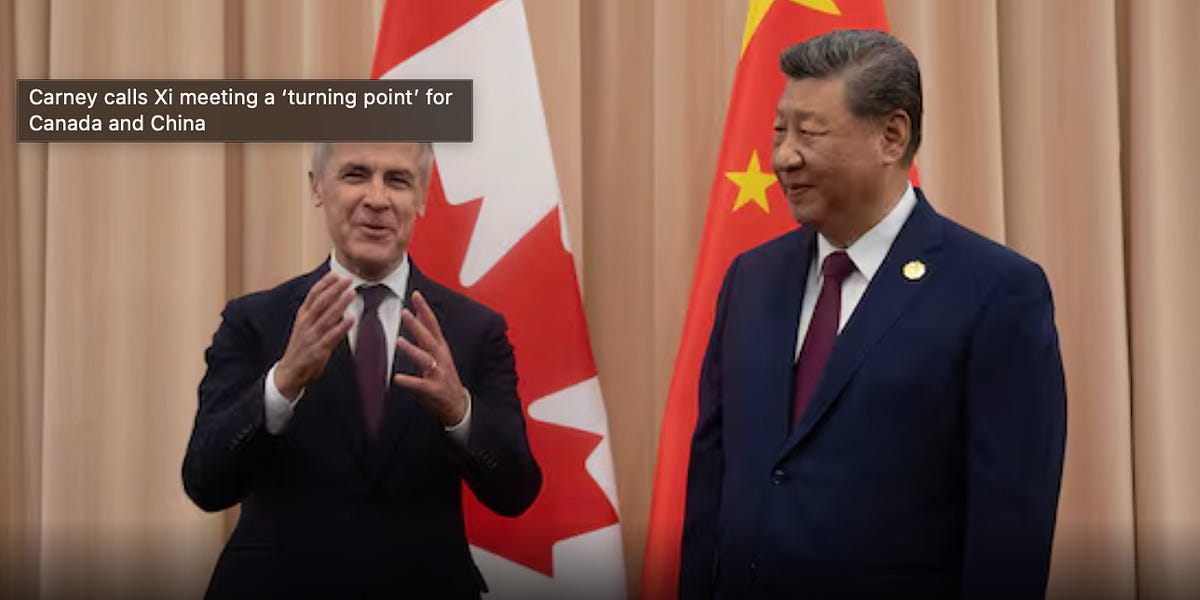
It’s a finding that resonates sharply as Justin Trudeau’s successor, Prime Minister Mark Carney renews deeper ties with Beijing amid Washington’s intensifying, security-driven tariff pressure on its allies.
Molinaro lays out his case, arguing that a double standard has taken root in Canada’s approach to China. He contrasts Justin Trudeau and the RCMP’s aggressive pursuit of Indian officials and linked organized-crime proxies with their persistent failure to confront comparable — and far greater — Chinese threats. This pattern runs through Trudeau’s testimony denying repeated intelligence findings on Beijing’s interference within his own party and government institutions, and through multiple examples across federal departments. Among them: Commissioner Marie-Josée Hogue’s conclusions on Chinese interference, which appeared to downplay or miscast stronger findings from an earlier NSICOP review, and the actions of Trudeau’s national-security adviser, who allegedly blocked or sanitized a report that “named names” of parliamentarians targeted by China — a case that echoes Britain’s unfolding Chinese-spy scandal.
In interviews with officials tied to congressional and Senate committees on the Chinese Communist Party, Molinaro uncovered a stark consensus in Washington’s intelligence community — one that, he notes, had solidified long before Donald Trump’s return to office. Ottawa, they said, is not merely slow to act on Beijing’s interference but increasingly viewed as a compromised link in the Western security chain — and therefore a liability to American interests.
“I asked them for an honest assessment of how the U.S. interprets its northern neighbour when it comes to PRC foreign interference,” Molinaro explains. “It’s worth mentioning that these comments were made before Trump’s election win and during Biden’s time in office.”
“I don’t want to say ‘joke,’” one official told him, “but the saying you get a lot of times here is, ‘Look to Canada if you want to see what could happen here.’” Another was even more blunt: “Canada is … overrun. I know some of the people I work with in the malign-influence space say ‘Canada is trying to stay afloat.’” Molinaro writes that these officials seemed to hold back some of what they knew, but when he asked why Canada “is trying to stay afloat,” the careful answer pointed to “certain perceptions within the Canadian government about China and Chinese influence.”
Molinaro stresses that this breach in American confidence is not academic. “The uncomfortable truth,” he concludes, “is that the threat of the PRC to Canada has been and remains a direct threat to the national security of the United States.” With both nations sharing intelligence pipelines, defence infrastructure, and deeply integrated economies, Ottawa’s paralysis magnifies Washington’s exposure. “The more Canada dithers on acting against PRC operations,” he notes, “the larger the risk to the U.S.”
That dithering, Molinaro argues, has become institutionalized.
Ontario is your greatest threat due to unaccountable apparatuses who enforce a caste and destroy our young for a lifetime. They would happily punish America if these unimpressive criminals had the resources and technological advancement.
First Canada aligned with the Soviets. Reagan dragged us away, forced Mulroney to separate RCMP powers and get closer to the U.S system. Since that short stint, Canada has reverted back to hating America and working with U.S enemies, mimicking them in many instances.
“Overrun”: Washington’s Grim Verdict on Canada’s CCP Infiltration Crisis
In Under Assault, expert Dennis Molinaro concludes that U.S. officials see Canada as struggling to counter Beijing’s expanding operations — a failure that increasingly threatens American security.
www.thebureau.news
OTTAWA — In his striking conclusion to Under Assault, former national-security analyst Dennis Molinaro reveals that U.S. government sources have privately described Canada as “overrun” with Chinese influence — the ultimate consequence of a fifty-year pattern, begun under Pierre Trudeau and seemingly accelerated by his son, of engaging the Chinese Communist Party on its own terms and to the detriment of Canadian sovereignty.
It’s a finding that resonates sharply as Justin Trudeau’s successor, Prime Minister Mark Carney renews deeper ties with Beijing amid Washington’s intensifying, security-driven tariff pressure on its allies.
Molinaro lays out his case, arguing that a double standard has taken root in Canada’s approach to China. He contrasts Justin Trudeau and the RCMP’s aggressive pursuit of Indian officials and linked organized-crime proxies with their persistent failure to confront comparable — and far greater — Chinese threats. This pattern runs through Trudeau’s testimony denying repeated intelligence findings on Beijing’s interference within his own party and government institutions, and through multiple examples across federal departments. Among them: Commissioner Marie-Josée Hogue’s conclusions on Chinese interference, which appeared to downplay or miscast stronger findings from an earlier NSICOP review, and the actions of Trudeau’s national-security adviser, who allegedly blocked or sanitized a report that “named names” of parliamentarians targeted by China — a case that echoes Britain’s unfolding Chinese-spy scandal.
In interviews with officials tied to congressional and Senate committees on the Chinese Communist Party, Molinaro uncovered a stark consensus in Washington’s intelligence community — one that, he notes, had solidified long before Donald Trump’s return to office. Ottawa, they said, is not merely slow to act on Beijing’s interference but increasingly viewed as a compromised link in the Western security chain — and therefore a liability to American interests.
“I asked them for an honest assessment of how the U.S. interprets its northern neighbour when it comes to PRC foreign interference,” Molinaro explains. “It’s worth mentioning that these comments were made before Trump’s election win and during Biden’s time in office.”
“I don’t want to say ‘joke,’” one official told him, “but the saying you get a lot of times here is, ‘Look to Canada if you want to see what could happen here.’” Another was even more blunt: “Canada is … overrun. I know some of the people I work with in the malign-influence space say ‘Canada is trying to stay afloat.’” Molinaro writes that these officials seemed to hold back some of what they knew, but when he asked why Canada “is trying to stay afloat,” the careful answer pointed to “certain perceptions within the Canadian government about China and Chinese influence.”
Molinaro stresses that this breach in American confidence is not academic. “The uncomfortable truth,” he concludes, “is that the threat of the PRC to Canada has been and remains a direct threat to the national security of the United States.” With both nations sharing intelligence pipelines, defence infrastructure, and deeply integrated economies, Ottawa’s paralysis magnifies Washington’s exposure. “The more Canada dithers on acting against PRC operations,” he notes, “the larger the risk to the U.S.”
That dithering, Molinaro argues, has become institutionalized.


