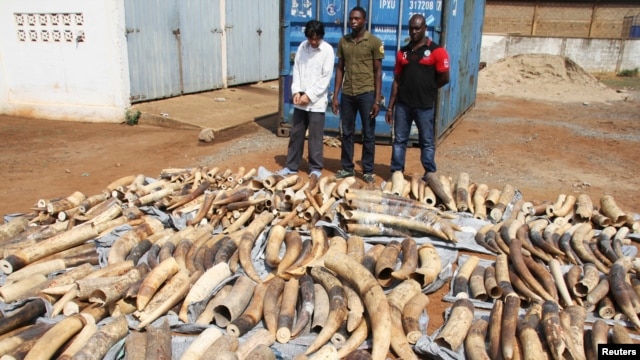
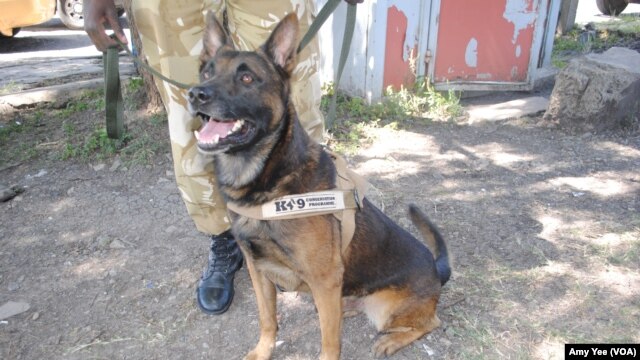
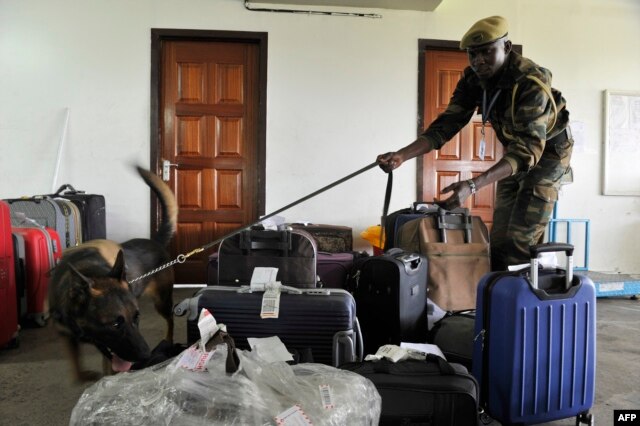
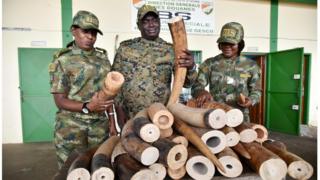
Researchers say the syndicates are run by Chinese and Vietnamese nationals working with corrupt officials and have become the main challenge in the fight against the illegal wildlife trade. They are involved in poaching and moving large illegal ivory consignments across Africa and then to Asia. Ivory carvings are prized in East Asia as status symbols. The finding by Traffic, a wildlife trade investigating agency, was based on the increasing number of Chinese and Vietnamese nationals being arrested during illegal ivory seizures. The small West African country of Togo is the latest hub for shipping large consignments of ivory, often from across the continent, to Asia, the report found.
Ivory processing in Africa
Researchers said some of the arrests also involved Thai and North Korean nationals. "At the present time, Asian criminal networks, often in collaboration with local political and economic elites, completely dominate the supply of raw ivory out of Africa," the report prepared for the Convention on International Trade in Endangered Species (Cites) said. "This is exacerbated by increasing evidence of direct Chinese involvement in Africa-based ivory processing operations in many countries including Angola, Congo, Ivory Coast, Democratic Republic of Congo, Mozambique, Nigeria, South Africa and Zimbabwe."
Illegal ivory trade at a glance:
* Largest ivory trade flow in Africa: Kenya, Tanzania and Uganda
* Largest trade outside Africa: China, Vietnam, Hong Kong, Singapore and Malaysia
* Main ivory processing centres in Africa: Angola, Congo-Brazzaville, Ivory Coast, DR Congo, Mozambique, Nigeria, South Africa and Zimbabwe
* Main storage location for ivory and rhino horns: Mozambique
* Main transit hubs in Africa for onward shipping: Togo and Malawi
* Main air transport hub: Ethiopia
Source: Traffic
Traffic recorded 61 cases of large scale ivory seizures between 2011 and 2014, almost double the numbers during 1998-2006. "In most of these seizures, Chinese and Vietnamese nationals were arrested," said Traffic's Tom Milliken, who wrote the report. The report found that 87% of the 2014 seizures in Ethiopia, an important air transport hub connecting Africa and Asia, involved Chinese nationals. It has identified Mozambique as a base where East Asian criminal syndicates can operate, mainly because ivory traffickers are not normally imprisoned. The Chinese and Vietnamese embassies there did not respond to the BBC's request for comment.
Big business